Friday, 31 May 2013

Closing Scotland's Gender Pay Gaps - if not now, when ?

Recent research shows that changes in the law in Scotland on how public bodies must report on gender pay gaps have not helped accelerate the rate at which pay gaps are being closed.

Although more bodies than before are reporting what the gender pay gaps are [see this blog post], what they are reporting and the picture it builds is not cause for breaking out the bubbly.

At 10th May 2013, out of the 92 public bodies examined in the research, 16 reported a pay gap within +or-5%.  Put that another way.  Just 17.4% of public bodies could claim to be delivering equal pay in the broadest possible sense.

At January 2013, the equivalent figure was 10 public bodies, meaning just 11% of the public sector could claim to have been delivering equal pay at that point.

At May 2013, 58 public bodies report gender pay gaps of between 5.13% and 31.9%.   Just a few months before that, research showed that 19 public bodies were reporting gender pay gaps of between 5.3% and 36%.  

While the number of public bodies providing gender pay gap data has increased dramatically, the scale of pay gaps being reported has barely changed.  One might reasonably conclude that the introduction of a specific duty to publish gender pay data has not accelerated the pace at which the gender pay gap is being closed.

What would Gwen Davis, Sheila Douglas, Eileen Pullan and Vera Sime have made of these figures, 45 years on from the strike action they and many other women took on equal pay as workers at the Dagenham Ford factory in 1968 ?

Scottish Government lacks the political will to close the gap within any defined period of time.  The STUC shows no passion for leading direct action across workers and demanding an end to the pay gaps, even in the lifetime of today's women workers.  Is it time for the sisters to look in  the mirror, draw inspiration from the women of Dagenham, and ask themselves on equal pay with men, 'If Not Now, When ?'.

Thursday, 30 May 2013

Equal Pay - the good, the bad and the downright ugly

Scotland's public bodies have had plenty of notice that by end-April 2013, they should publish data on their gender pay gaps. The regulations published by government, better known as the specific equality duties, could not have been clearer:


.... a listed authority must publish information on the percentage difference among its employees between men's average hourly pay [excluding overtime] and women's average hourly pay [excluding overtime] ....

Even the only idiot in the village would get what was needed.  You would have thought.

But then the public sector in Scotland has had years of practice in ducking and diving away from the delivery of what it should have been doing.  Equal pay for women has been a legal obligation for over 40 years now, and still it remains out of reach for most women.

Recent research shows that out of 92 public bodies scrutinised, at 10th May 2013, 74 had published gender pay gap data.  This represents an 80% compliance rate.

At January 2013, the results of previous research into councils, health boards, universities and other public bodies showed that out of 91 public bodies surveyed, 29 had published gender pay gap data.  This represented a compliance rate of 31.8%.

One might conclude on this part of the evidence that the introduction of a specific duty to publish gender pay gap data has had a positive effect.  Not when you go on to examine what has been reported - more on that in another blog.

What is astonishing is that 18 public bodies had ignored their legal duty to publish by 30th April.  Two-fingers were waved at the law.  The Equality & Human Rights Commission [EHRC] reaction when advised of the research outcomes ?  A sucking of teeth and a sniffy dismiss to the research, claiming that they could only act on research they had commissioned and that if any public body was found to be non-compliant details "would be passed to legal".  

It beggars belief.  Elsewhere in the real world, more and more credibility is being given to the role of whistle-blowers in calling time on bad/illegal/unsafe/unlawful practices.  Not in the EHRC apparently.  More time must be allowed to pass, more scarce public funding to be spent, more sucking of corporate teeth before deciding if non-compliance should result in a big stick being wielded, as against a nice, friendly, informal word on the quiet in the drawing and dining rooms of suburbia where Scotland's middle-class state apparatchiks regularly meet and decide how 'people like us' will continue to portray a vivid picture of reform and action which, when the smoke clears, presents a picture of equality for and power-sharing with 'people not like us' which is not significantly different from that of 30 years ago.


Equality and the golden showers of tax avoidance

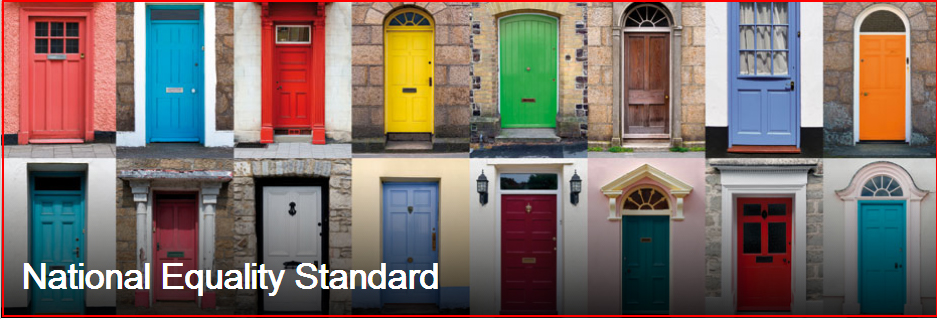
This week someone drew my attention to one of the 'Big Four' of the UK's accountancy consultancies announcing the launch of a National Equality Standard.  Hailed as a 'groundbreaking initiative' it is a tool for the business world and claims it fills a gap because there has been no industry recognised standard for equality, diversity and inclusion.

For those who doubt the accuracy of my reporting, read the web site statement for yourself here.

Ernst & Young have developed and sponsored the national equality standard with 18 other UK and global companies.  It is supported by the Equality & Human Rights Commission.  It just keeps getting better, doesn't it ?  Those of us devoting years to slaying the dragons of inequality can all pack up and go home.  Ernst & Young have got it sorted.

Or have they.

No evidence is offered of the EHRC backing, supporting or endorsing the national equality standard for business.

No mention is made on the EHRC web site of this must-have tool for business.

No evidence is offered that the tool requires the deep, permanent involvement of people from the equality communities to change the daily lived experiences of prejudice, discrimination and barriers encountered by people when using services provided by the private sector.  And when you look at the graphics [below] used on the Ernst & Young web site, you might find a clue.


There are no people.  No people going in or out of the business entrance doors.  No people even passing by in the street.  Just how this is supposed to project a sense of private sector business being open to and ready to meet the different needs of a diverse population is deeply puzzling.

Given the current debate around the minimalist tax bills paid by such as Amazon, Google, Starbucks and the rest, it does seem strange that one of the 'Big Four', who helps business minimise tax bills and so leave the rest of us pay more tax to make up the shortfall, should be interested in equality at all.  Their core business is the very deliberate creation and protection of inequalities in the distribution of wealth.  It is only a few months ago that Ernst & Young agreed to settle a court case in the US and pay a fine of $123 million for the promotion of abusive tax shelters to rich individuals.  

I have asked both Ernst & Young and the EHRC for evidence of their partnership in what feels suspiciously like yet another golden shower from the private sector.

In just under 24 hours since posting this blog, the EHRC senior press officer has confirmed :
"we support the initiative".
Not only has the EHRC sold its soul cheaply, it has paved the way for government to hand over what little work it really wants done on equality to the private sector and wind up the toothless, heartless and now soulless Commission.  


Tuesday, 16 April 2013

Has NHS become a no-go area for compliance with equality laws?

Over this last 12 months, the performance of the NHS in Scotland has been so shambolic it is difficult to conceive that there is a government minister in charge.
Nicola Sturgeon, former Cabinet 
Secretary for Health & Equality

The fiddling of waiting times by NHS Lothian, first revealed early last year, just won't go away.  Just days ago, yet another error in the waiting list figures given to the Lothian Board was found.  Given the previous Cabinet Secretary for Health, Nicola Sturgeon, did not replace either the entire senior management cohort or the members of the Lothian Board itself but instead asked them to clear up their own mess, suggests a naive belief that the resignation of the previous NHS Lothian chief executive was a sufficient catalyst for change.

If the Laurel & Hardy waiting times act were confined to NHS Lothian, there might be some small comfort in that.  Not so.  An investigation by Audit Scotland revealed 
"The management and scrutiny of the waiting-list systems have not been good enough.  During the period we reviewed, the Scottish government and boards were focussed on making sure waiting times targets were being met but not giving enough attention to how this was being done."
The complete reveal of the shambles across Scotland is in this report from Audit Scotland.  The slings and arrows at NHS Lothian show no signs of abating, with a report last month revealing complaints from Lothian patients surging upwards by 20%.    

One of the many elephants in the room which houses the NHS in Scotland has to be if management and scrutiny of waiting lists has not been good enough, how can we be confident the management and scrutiny in other areas, such as meeting the equality duties, has been good enough?  We can't.  Successive government ministers have refused to build central performance management data systems which would allow government to track, in real time, health board performance on a range of critical areas.

In the last few months, research has been published which shows the performance of health boards on meeting the equality duties begs the question that the same malaise found in performance on waiting  times may also be affecting performance in the NHS on equality.

In delivering Equal Pay, health boards seem determined to break the law and ignore promises made by the Cabinet Secretary for Health in 2009.  In October 2009, Nicola Sturgeon responded to a question from the Scottish Parliament's Equal Opportunities Committee :
'It was indicated [at a previous Committee round-table discussion on equal pay reviews] that advice had been given to NHS boards not to perform equal pay reviews to ensure that agenda for change remains equal-pay-proofed. I want to clarify that that is not the case. There remains an issue about the extent to which such reviews can be carried out while agenda for change reviews are under way, but there is a clear expectation that all boards will get on and complete those reviews as quickly as they canand that they will go beyond the letter of the law to ensure that they are exemplary employers that live up to all the duties required of them.' [6th October 2009]
In 2012 I conducted research across all of Scotland's councils and health boards to clarify just what the equal pay gap is in Scotland's public sector currently.  Three years on from that very clear and unequivocal assurance given by Nicola Sturgeon to the Scottish Parliament, I have found that across the NHS in Scotland’s 22 Boards, just 2 [9.09%] of the Boards were able to provide data on the gender pay gap. This shows a gender pay gap of either 4.3% at NHS 24 or 12.9% at the NHS State Hospital. 
This means that just 1 Scottish NHS Board has a gender pay gap which comes within the 5% criteria set by the EHRC.
I shared that research with government.  No reaction.  No plan to shake the health boards out of their almost pathological aversion to meeting the law and stopping the theft from the pay packets of women.  Not only are health boards not going beyond the letter of the law as Nicola Sturgeon said they would, they are ignoring it and have been ignoring it for some time.

More recent research into Equality Impact Assessment of health board budgets, shows how deep the equality crisis is in the NHS.  Just 1 of the 22 health boards offered an EQIA of their budget, with the other 21 Boards unable to offer a consistent reason for not checking their budgets for discrimination and adverse impact on people from the equality communities.

 NHS Lothian claimed that a single EQIA of its big [£1.4 billion] budget would be "meaningless".  Another health board said they did not do an EQIA as they were "not withdrawing services".  The health board which hosts a dedicated equality unit supposed to assist all other health boards with equalities work, NHS Health Scotland, said simply "NHS Health Scotland has not conducted an impact assessment of the budget".  

Our NHS is spending £multi-billions a year and has no credible system in place for checking that the equality bang from each and every pound spent is squeezed to the max.  It has for too many years been complicit in stealing from the pay packets from women as it avoided its legal duties on equal pay.  Its record on race equality and disability equality is threadbare, with a track record of producing equality schemes consuming several hundred pages of print from which emerged little measurable difference in the life experiences for black minority ethnic or disabled people when accessing and using the NHS.
Alex Neil, Cabinet Secretary for 
Health & Equality

The NHS is in deep trouble.  Audit Scotland has found performance management and scrutiny to be not good enough.  Evidence is piling up that health boards are breaking the law on equality.  It is as if health has become a no-go area for equality in Scotland.  Government and the EHRC need to enforce compliance by all health boards with all equality law and fast.  

Saturday, 13 April 2013

Where's the beef in the equality commission in Scotland ?

A few weeks ago, parliament lightly grilled the Equality & Human Rights Commission [EHRC] in Scotland on what is was going to do with considerably reduced resources to eliminate discrimination and promote equality of opportunity   The Equal Opportunities Committee did the grilling and the Official Report describes only too well just how the heat of scrutiny exposed the lack of beef in the evidence burger [though there was a lot of cheese] offered up by the EHRC.  If you prefer to watch the sizzle of fat in the fire, you can catch up with the archived parliament tv video of the session.

Baroness Onora O'Neill of
Bengarve, part-time EHRC 

Chair  and part-time fish-fryer
One of the early areas of interest was around the Helpline, which used to be run by the EHRC but which was put out to tender by government and awarded in 2012 to a partnership between the private and voluntary sectors.  

In column 1070 of the Official Report, the Committee was told that the helpline advises only employees and service users, not employers.  Clarity on this issue was not helped when the Scotland Director in comments immediately beforehand invited his colleague to clarify what the new helpline offered employers when in fact employers are not offered advice or guidance by the helpline.  The issue cropped up again in 1071 when a Committee member referred to the helpline being aimed at smaller employers.  The EHRC delegates did not correct this confusion.  Maybe they were taking their lead from the Chair of the EHRC, Baroness Onora O'Neill of Bengarve, who is well known as being a part-time philosopher fish-fryer and seems content to see government dismantle the EHRC piece by piece, page by page.

Even once the confusion is cleared up, the gap remains - there is no helpline for employers.  Scottish government needs to consider providing an advice/help line for employers and for service providers.  The continued absence of a structured and focused help/advice line for this group will inevitably have an adverse impact on the rate at which equality is delivered.  

References to the Helpline and its flaws crop up throughout the evidence session, with the EHRC team conveying to the Committee an impression that it is a somehow well-intentioned and innocent bystander in the unfolding disarray and that somehow, if it was all back in their hands/direct control, the sun would shine more often and the helpline would provide more information to more people.  If you listen carefully, you can just about hear Judy Garland soundtrack the evidence session with 'Somewhere over the Rainbow'.

The EHRC somehow omitted to share with the Committee that it sits on a reference group established to oversee the operation of the new Helpline and that a meeting of that reference group took place the week before the Committee session with the EHRC.  Two EHRC staff were present at that Helpline reference group and did not raise any of these concerns with the operators of the Helpline nor with the staff from Government Equalities Office [GEO] staff who were also present.

This was but one example of how the apparently succulent beef-burger of evidence offered by the EHRC turned out to taste suspiciously like horse-meat.  A critique of the horse-burger cooked up by the EHRC team, crinkle-cut gherkin and all, for the Committee can be read here.

Thursday, 11 April 2013

Budget cuts in the public sector – deepening the grip of discrimination ?


Equality Impact Assessments [EQIAs] have become ever more crucial in these last few years of deepening recession and year-on cuts in public sector budgets and services.  In 2007-08, an organisation called Southall Black Sisters [SBS] faced funding cuts from Ealing Council in London.  This would have meant the complete closure of its operations.  Ealing Council argued that specialist groups were no longer necessary and pushed its own interpretation of ‘Social Cohesion’.  SBS users challenged Ealing Council and won a landmark victory at the High Court, deeming Ealing Council’s action as unlawful and contravening the Race Relations Act.  Part of the ruling included a clear indication that the courts expected public bodies to have formal written evidence that they had showed due regard to the equalities implications of their decisions and that EQIAs were recognised as good practice models of such evidence.  

The Equality & Human Rights Commission [EHRC] produced and published guidance on the need to compile evidence that due regard was given to equalities, particularly in financial decision making, and disseminated this widely.  The EHRC clearly favoured EQIA as the tool for this work, while recognising that it was not the only tool to achieve the end result – compiling evidence that decisions in budget setting had paid due regard to the 3 elements of the general equality duty.


With that history, it seemed a good time to research just how well public bodies in Scotland are doing in following the EHRC guidance on impact assessing their budget plans for financial year 2013/14. Given the vast amounts of money spent by both councils and health boards, it is essential that it is checked for evidence of discrimination and, where found, for that to be designed out.  In 2011, councils spent around £21 billion [£11.5 million in government grants], employed about 240,000 full-time equivalent staff and used buildings and other assets with a value of about £35 billion.  Health Boards are expected to spend around £11.6 billion in government grants during 2012-13.  That level of financial spend suggests enormous scope for identifying and eliminating discrimination which too many people still encounter on a daily basis in Scotland.


The research reveals overwhelming evidence, submitted directly by public bodies themselves, that the legislative framework on equalities is being routinely ignored.  Most councils and health boards seem to have taken their lead from the Rhett Butler style of management, effectively telling Baroness O'Neill, part-time fish-fryer of the EHRC, that 'frankly my dear I don't give a damn ... about equality'.

Alongside this, it is also clear that the tactical strategy of the EHRC – to encourage public bodies to deliver equality through guidance and support rather than enforcement – is unfit for purpose and is failing to secure the elimination of the discrimination which blights the lives of people when using public services.  

In the particular context of this research, it has become obvious that the default cultural mind set in the public sector is to deny that there is any real depth or extent to discrimination within the sector.  The discourse within budget EQIAs is not on ‘cuts’, but almost always on ‘savings’.  The narrative within EQIAs rarely references discrimination, as if by airbrushing the word out of the public sector lexicon it can, in some parody of ‘Animal Farm’, demonstrate that all are already equal and indeed that some are more equal than others.

Without the radical changes recommended in the research, the structural and institutional discrimination which is inherent in the setting of public sector budgets will continue to flourish unchecked and will in turn continue to present a major barrier to all other work on eliminating discrimination and providing equality of opportunity.


Saturday, 23 March 2013

We are forgetting to remember, and so giving our permission for the killing of more BME people

At some point yesterday [21st March 2013] I became aware that I had not fallen across much in the media, political or public sector worlds which reflected the fact that it was the day on which we take time out to ponder racial discrimination, not as something far away but as something very close to home.

The day is backed by the United Nations and reminds us that in 1960 on the 21st of March, police opened fire and killed 69 people at a peaceful demonstration against the apartheid "pass laws" in Sharpeville, South Africa.  In 1966 the UN declared 21st March as the International Day for the Elimination of Racial Discrimination.

Some of us have used pivotal events like Sharpeville to provide a backstop to the work we do on identifying and eliminating discrimination.  In the UK we have the death of Stephen Lawrence to remind us of the racism which is part of the fabric of our own institutions and culture.  Part of our work is in reminding our colleagues, our neighbours, our families and friends that while apartheid and pass laws may have been ended in South Africa, while the Macpherson report into the death of Stephen Lawrence may have acted as a catalyst for real work starting in the UK on race equality, across the world and here in the UK, discrimination is still an everyday experience for far too many black minority ethnic people.  

Oddly, the ubiquity of smartphones and social media means we can now play and replay incidents of racism, and remind ourselves of the ugly reality that the country many of us call home is bigoted and racist.

I searched the internet for evidence that the opinion formers, the great and good, our public institutions, were using the UN Day to trigger some fresh thinking, some innovative actions with which to renew efforts on tackling the hydra-headed forms of racial discrimination taking place each day across the UK.

I looked on the web site of the Equality & Human Rights Commission.  Nothing.  Zilch.  Nada.  Same big fat zero on the web site of the Scottish Human Rights Commission.

The brothers and sisters of the STUC, the TUC, Unison and Unite had nothing on their web sites to affirm to visitors that fighting racism was part of the trade union agenda.  I browsed the web sites of Labour, Conservative, Lid Dem and SNP political parties.  Nothing.

I looked at the home pages of the Guardian, Telegraph, Glasgow Herald, Independent and Scotsman newspapers and found the same, nothing.  I looked at the home pages of the BBC, STV and Channel 4 news and found news landscape where racial discrimination is rarely featured.

I looked across our public institutions.  Scottish government, its Equalities Minister Alex Neil and its Equality Unit allowed the defining moment in world history of Sharpeville to go unremarked, as did our NHS, our city Councils, Cosla, the churches and many, many others.  Scotland's Parliament had nothing to say on the day and the business bulletin of the Parliament that day had no remembrance. 

We are forgetting to remember.

We are forgetting why we need to remember.
Sharpeville, 21st March, 1960

By forgetting to remember, we also forget the death of people at Sharpeville, the death of Stephen Lawrence, and the too many other deaths.

By forgetting those deaths and the lessons they taught us, we are giving our permission for the killing of more black minority ethnic people in years to come.