Monday, 17 July 2017

Roots of institutional racism remain deep and undisturbed across much of the NHS in Scotland

500 years ago one Niccolo Machiavelli wrote [I paraphrase] that the status quo will defend itself, and all its many privileges, with great vigour against change to how things are.  When it comes to making race equality in employment happen in NHS Scotland as opposed to working towards it, then not a lot has changed in the last 50 years.

In 2012, Scotland patted itself on the back with the adoption of what was described as a better set of regulations on making equality happen than were put in place in other parts of the UK.  Some 5 years on and several thousands of pages in multiple equality reports published by Scotland's NHS Boards under the Scottish equality regulations, and the data suggests those charged with enforcing the regulations had not studied or read Machiavelli at university.  Or maybe they just thought he was Liza Minnelli's grandfather ? 

In the 3 cycles of employment equality data reports published by Scotland's 22 NHS Boards, their own figures show that the proportion of Black Minority Ethnic [BME] people employed in the NHS has fallen from forming 2.77% of the workforce in 2013 to 2.44% in 2017.

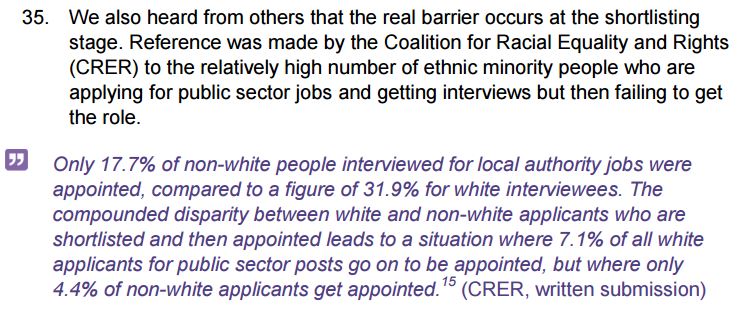
To get and keep a job anywhere, you first have to succeed in what is often termed the recruitment stage.  Research in recent years has shown this is not a place where equality flourishes, and certainly not for BME people.  In 2016, the Scottish Parliament's Equal Opportunities Committee found that there was a disproportionate failure of BME people at interview stage.
 

With that in the background to NHS Boards preparing their 2017 employment equality data reports, one could have been forgiven for presuming this area of their culture and practice would feature heavily in their 2017 reports.  On the basis of an analysis of the employment data reports published by NHS Boards in 2017, there is an almost total lack of evidence that active and positive use is being made of the employment data gathered on recruitment to show that Boards are creating discrimination-free gateways to equality of opportunity for BME people in getting and sustaining employment within the NHS.  

an almost total lack of evidence ... Boards are creating discrimination-free gateways to equality of opportunity for BME people

It would not be unreasonable to conclude that on the basis of what has been published, the recruitment systems and cultures in the NHS have changed little if at all since the Equality Act 2010 and that they act as a bulwark to the status-quo of a predominantly non-BME workforce.

It gets no better when looking at the other end of what comprises a job with Scotland's NHS these days - that point where you walk away.  The intention behind the equality regulations was that employers would gather data on people who had left, find out why they had left, compare the patterns of BME people with non-BME people and use that to find out if there were underlying discrimination which triggered resignations from BME people.  

The extent to which Boards are failing to gather and use data on BME people leaving employment, and why, is astonishing


What appears to be an almost casual disregard amongst Boards for undertaking proper scrutiny, as set out in the specific equality duties, of why BME people are leaving employment inevitably means the potential for racial discrimination being the trigger for people deciding to leave employment will continue to remain hidden by poor data gathering systems and organisation cultures.  

the potential for racial discrimination being the trigger for people deciding to leave employment will continue to remain hidden by poor data gathering systems and organisation cultures

This latest examination of employment data published by Scotland’s 22 NHS Boards suggests little has changed since the Equality Act 2010 and that if anything the roots of institutional racism remain deep and undisturbed across much of the NHS.  What has emerged in this particular research report is growing evidence that the NHS in Scotland is reluctant to willingly and comprehensively embrace all that the specific equality duties requires as this would more than likely unearth practices and cultures which are racist and which would require institutional change.

Friday, 17 February 2017

NHS in Scotland has hung a 'DNR' on the too-long neglected concept of human rights

At any given time, the majority of US citizens are able to identify some of their rights as enshrined in their revered constitution.  Amendment 2 relates to the right to 'keep and bear arms'.  Some would argue that knowledge of this right is almost world-wide, such is the cultural impact of the US and of Holywood on the rest of the world.  


In similar terms, many people across the world are as familiar with the 5th Amendment as are most US citizens - the right to refuse to answer a question on the grounds of self-incrimination.

The nearest equivalent here in the UK is the 1998 Human Rights Act.  Sadly, the knowledge of UK citizens of their human rights is markedly less widespread than that of US citizens of their constitutional rights.  It may be of course that tabloid press coverage of human rights cases has tended to sensationalise the use of human rights laws to the extent that they are commonly, and negatively, associated in that part of the public mind informed by the tabloid press with refugees and prisoners.

It is not enough to blame the red-tops for the jaundiced view many have of human rights. 

Age UK published research in 2011 on Equality & Human Rights in Practice.  On Human Rights it found : 
Human rights are basic rights that belong to everyone simply because we are human. They are an important means of protection for people in later life, especially those who face abuse, neglect and isolation, and can be empowering tools for older people to advocate for their own rights. The Human Rights Act (1998) is, however, absent from much of government policy-making in relation to older people. Within many parts of government, human rights are so little understood that conversations using human rights ‘language’ are ineffective.
In 2010, NHS Health Scotland published a report which found that :

The overall theme within NHS Scotland was that few health boards had taken action on human rights as they were unclear about what is expected of them or wanted guidance on this. However, there was recognition of the need to comply with human rights law and good practice and a willingness to do so.

Translation ?  Senior, well-paid, staff running the 22 NHS Boards knew they should be doing something on human rights.   But because politicians and civil servants had not told them what they should do, they did nothing.  Because politicians and civil servants have mot been holding them to account on what they should be doing on human rights [like empowering service users to know their human rights], they have got away with doing nothing for the best part of 17 years. 

The Working Group behind the NHS Health Scotland report recommended Boards in Scotland should use a Human Rights Based Approach.  A critical part of this approach was commended to NHS Scotland :
NHS Scotland will take steps to ensure that everyone within the NHS (including staff, volunteers, patients, carers and families) is aware of and empowered to claim and enforce their rights.
Recent research on how much use the NHS in Scotland makes of a Human Rights Based Approach revealed that for all the claims to 'do' human rights, there is precious little evidence that Scotland's NHS service users even know what their human rights are.

Scotland's 22 NHS Boards were asked via a Freedom of Information request to provide a count of exactly how many service users they had helped empower with a knowledge of their human rights and the capacity to claim them.  Once the fluff, jargon, double-speak, confusions and digressions had been stripped from the 22 responses, the count revealed that over the last 3 financial years, Scotland's 22 NHS Boards had manged to empower exactly 0, zero, zilch service users with a knowledge of what their human rights are.

Boards were also asked to provide a count, over the same 3 years, of how many claims had been submitted to them by service users of cases where their human rights had been ignored or breached.  Keep in mind that the NHS in Scotland has at least 26 million interactions with service users each year.  Over the last 3 years once can reasonably assume that the number of interactions would have been in excess of 78 million.  During that whole time, not a single one of those 78+ million interactions was carried out in such a way as to cause a service user to claim that their human rights had been ignored or breached.

The submissions received from all 22 NHS Boards early in 2017 suggests little has changed from the findings of the 2010 NHS Health Scotland report.  It seems that since the 1998 Human Rights Act took effect in 2000, the NHS in Scotland has been keeping the concept of human rights in the NHS on the barest minimum of life support systems.  Starving service users of the oxygen of knowledge that they have human rights in a health setting is clear evidence that the NHS in Scotland has hung a 'DNR' on the too-long neglected concept of human rights, which has been dumped on a trolley and pushed out of the way and into some long-forgotten dusty NHS policy corridor leading nowhere.


Wednesday, 26 October 2016

WASPs still in control of 21st century public sector Scotland

Just two years ago, the number of political appointments made by government ministers to run Scotland's public sector on behalf of government was 574 seats at 78 boards.  Today, the number of seats within the gift of ministers is 638, spread across 86 public sector boards.  That is a lot of favours to award.

Back then research revealed that :
When looked at through the lens of equality, the reality of who runs Scotland becomes clearer; not so diverse, a tad pale, dominated by suits and imbued with good old Presbyterianism.  WASPs.
Who runs Scotland is more than just a question of who sets the strategic direction for the public bodies and who holds senior paid staff to account for their performance in delivering - or not - the strategic goals set for each public body and its staff.  Board members, appointed by government ministers, are also crucial to how the culture and values of public bodies can be made to change and evolve to embrace equality diversity or, in some cases, remain WASPish in outlook and continue to develop and deliver services focused primarily on the needs of PLUs [people like us, WASPs].  

Eliminating discrimination requires a complex, multi-faceted approach to changing how society works, and the composition of Board members is a small but critical element in ensuring the culture and values of public sector organisations are receptive to the changes required to eliminate discrimination.

Several decades have passed since the Equal Pay Act of 1970 first prodded organisations to start closing the equal pay gap.  Research from 2015 shows that in Scotland's NHS, the equal pay gap, averaged across all the 22 Boards, was 18.85%.  Research from 2014 on the equality profile of public sector boards, including Scotland's 22 health boards, showed that women held just 35% of board seats and even less, 19%, of the positions of Chairperson of these boards.  Men in the majority across public sector boards are unlikely to push the senior staff reporting to them into making faster, permanent changes to the cultures and working practices which underpin an equal pay gap in our NHS of nearly 19%.  Ensuring a proportionate share of board seats, 51% of them would do it, are occupied by women should help accelerate the pitifully slow pace at which the equal pay gap is being closed.


More recent research has looked, two years on, at what has changed since the original research on the equality profiles of public sector boards.  In terms of overall share, progress has been made with women now taking 42% of seats.  Sadly, the same kind of progress is not being made in those who act as Chairperson of all the boards.  Women have moved from having 19% of these in 2014, to having just 22% of these now - leaving men with 77% of the Chairperson roles.


In 2016, the overall picture developed from government’s own data suggests WASP males continue to dominate the boards which have strategic control over deciding the shape, nature and culture of what we call public services.  The presence of disabled people has declined in numerical terms across all boards while they have made some very modest progress in leading boards as Board Chairperson.  Overall, the disability equality gap on boards remains in significant deficit.

The race equality gap of BME people in place across boards in Scotland is such that government struggles to find data which shows it is achieving anything more than simply making up the numbers. 

In sexual orientation, LGB people continue to be a community of people who, proportionately, have enjoyed more success than other communities in gaining a share of the power sharing arrangements through taking some of the 631 seats across Scotland’s public sector.

In Scotland’s long struggle with acknowledging sectarianism exists outwith football grounds, government’s data on Catholic people occupying the 631 public sector board seats does show there is a marked gap in favour of Protestant people, and that Protestants also take a disproportionate majority of places as Board Chairperson in the 79 Chairperson’s in place at September 2016.

If the cultural and institutional discrimination which is all too obviously present in Scotland’s public sector, and which shapes the daily experiences of people accessing all public sector services, is to be eliminated, then the make-up of the boards of Scotland’s public sector needs to offer witness to a lead by example from government itself in eliminating discrimination in how they appoint people to those boards.  Until the death-like grip exerted by WASPs on the levers of power in the public sector is removed, equality remains a vague, never to be delivered, promise and instead the grim reality continues where the golden showers continue to fall with deliberate and conscious discrimination on the already excluded and marginalised.


Tuesday, 14 June 2016

NHS unable to evidence discrimination eliminated in health services - is equality a virtual reality for government ?

For a long time now, the institutions which make up so much of what we call society [police, schools, councils, health services and much more] have had legal responsibilities to identify and eliminate discrimination in what they do on our behalf and in what they provide us when we need to use their services.

It is worth remembering that the reason for the law on discrimination is not simply to allow public bodies to look as if they are doing something by sometimes elaborate dressing the window of their public face.  It is intended to bring about lasting and permanent change to how people experience what they do.

There are times when it appears that for the mainstream media, which reflects back mainstream society, equality occupies a similar curiosity joke shop to that where they shelve repeating stories of EU regulations on bent bananas and Health & Safety Executive directives on conker competitions at school.  Equality and the elimination of discrimination often seems to be covered in similar vein to the all too common media-inspired faux outrage over the human rights of prisoners, migrants and asylum seekers.

Discrimination is something which many thousands of people encounter on a daily basis and who find their lives, today and for years ahead, shaped and warped by that experience. This could be the impact on the pay cheques of women working in Scotland's health service who, according to data published by health boards themselves, earn 18.85% less than men [even though Scotland's Fist Minister promised to fix this Equal Pay Gap in 2009].  It could also be the BME people not working in the NHS.  Using data published by health boards themselves, we find BME people make up just 2.37% of the NHS workforce while they make up at least 4% of our population.

Women in the NHS earn 18.85%
less than men - Scotland's First
Minister promised to fix this Equal
Pay Gap in 2009
Since 2010, public sector bodies in Scotland have been given very clear guidance on how to evidence equality in their role as employers.  Major amounts of data, not always of high quality, has been published by health boards and, when analysed, shows that discrimination is stubbornly clinging, like some anitbiotic-resistant virus, to the cultures and practices of health boards as employers.

While there is no similar clear guidance on how to evidence equality in their role as service providers, some public sector bodies have started to gather and publish evidence that shows them where discrimination is identifiable in their services and so allowing them to take specific action to eliminate it. Stirling University is able to gather and analyse data on students which allows it to evidence that :
Proportions of students achieving a 1st or 2:1 are very similar between BME students (67%) and white students (69%) which is a significant improvement from the position in 2011/12
In an effort to uncover exactly what our health boards are doing to eliminate discrimination in how people access, experience and secure outcomes from their use of health services across the country, research was undertaken earlier this year and using a Freedom of Information [FoI] request sent to all 22 Boards.  
It would not be unreasonable to conclude from this research that most if not all of Scotland’s Health Boards are at real risk of failing to have evidence that they are meeting the public sector equality duty on eliminating discrimination in the provision of services.

Similarly, there is strong evidence that institutional discrimination is present in the culture and practice of Health Boards providing services to people from all the protected characteristics.  Until this is recognised and admitted by Boards themselves, the point of arrival at a time where achieving the goal of eliminating discrimination can be heralded is being pushed ever further into the future and left as something to be achieved by another generation.

None of this will be news to the Chief Executives of all Health Boards in Scotland. Providing leadership on how staff meet the public sector equality duty on services is part of their job. None of it will be news to the Board members of each Health Board, appointed by government to provide effective governance to how each Health Board operates, including being satisfied that the legal duties, such as the public sector equality duty, are being met. They are supposed to ensure that the Chief Executives and staff provide them with formal reports which assure them legal duties are being met and at formal meetings doing a lot more than simply nodding through papers presented by the paid staff. Indeed, such is the apparent apathy at strategic level across the NHS on compliance with the public sector equality duty that one could be forgiven for thinking recent media reports on record levels of laughing gas abuse have underestimated the scale and spread of the abuse.

First Minister has been spending too long
with the virtual reality kit and is mistaking
what she sees there for what is really
happening in the unequal world she
is failing to change

And of course none of this is news to Ministers in government. They have access to the same data or - as this most recent research reveals - the lack of data. Making real, measurable, evidenced equality happen and removing discrimination from people's daily lives seems beyond the will or the wit of government. It would seem the First Minister has been spending too long with the virtual reality kit and is mistaking what she sees there for what is really happening in the unequal world she is failing to change. 

Thursday, 24 March 2016

Could disabled people get more jobs working in NHS Scotland if Jeremy Hunt was in charge ?

In a week where the political shambles of another botched budget saw yet another attack on support for disabled people shelved, data is published which shows that equality of employment opportunity for disabled people in the NHS in Britain is poor and with disabled people in Scotland facing deeper levels of discrimination than elsewhere in Britain.

Government data indicates that around 16% of the working age population in Britain is disabled.  The same data source indicates that 46.3% of disabled people of working age are in work, compared to 76.4% of non-disabled people.This data confirms that structural and institutional discrimination remains a major obstacle in employment equality for disabled people.

The NHS across Britain has been undertaking distinct and focused work for some years now to eliminate that discrimination.  In Scotland, running the NHS is a devolved function, and the current government has been running the NHS - and the work on eliminating discrimination - since 2007.

In NHS England, the proportion of the workforce identifying as disabled is 2.58%.


In NHS Wales, 1.07% of the workforce identifies as disabled.


In NHS Scotland, where complete responsibility for performance in all areas, including making equality happen, rests entirely with Scotland's government, the proportion of the NHS workforce identifying as disabled is 0.94%


A dismal performance and a poor advert for independence.

Using these figures, one could argue that if NHS Scotland was being run by the same people who run NHS England, the number of disabled people employed in NHS Scotland would increase from just 1,550 to 4,227.

Disabled people in Britain are not just being failed by Cameron, Osborne and Hunt, they are also being failed by Sturgeon, Swinney and Robison.

Wednesday, 9 March 2016

Wannabe world-leading NHS Scotland takes the wooden spoon on race equality in its own back yard

Power. The part-aphrodisiac, part-narcotic for career politicians. 

The SNP has been wetting its beak in the Scottish version of this drug, heavily stepped on with porridge oats, since 2007. The SNP looks to continue its addiction to power in this year's parliamentary elections and so mark over a decade in power in Scotland, pulling the levers which decide what changes where and how deeply and quickly.


One of the areas in which the SNP has had complete freedom for the past 9 years to control and direct is in the NHS. The SNP's strategy for Scotland's NHS is that by 2020 it will deliver 'world-leading healthcare'. 
Equality gets no mention in the strategy, beyond some mealy-mouthed, management-speak in a 2 page summary of the strategy where it is explained that being a world-leading healthcare system requires : Recognising and valuing diversity. One could wonder that VisitScotland in airbrushing a young BME man into an otherwise all-white poster celebrating a Homecoming 2009 in Scotland, shows exactly what government means by 'recognising and valuing diversity'.  


One of the clear measures of equality is to be found in the profile, by protected characteristic, of those in employment.

Being in employment can bring multiple, potentially positive, impacts on the lived experiences of many people who share particular protected characteristics.  It can reduce dependence on the less than generous state welfare system and the increasing stigma attached to what little support is provided to people who are jobless for whatever reason.  It provides the opportunities for those previously excluded from key areas of society to be able to influence change and the future shape of societal structures from within.  

The Equality Act 2010 resulted in differing approaches being taken across Britain on how the underpin, usually in the form of different specific equality duties, guided the public sector in the general equality duty to eliminate discrimination.


Equality Here, Now has, in recent years, published research findings into establishing just how much Scotland’s specific equality duties, adopted in May 2012, have achieved in eliminating discrimination in the employment practices and cultures of the public sector.  

Recent research from Equality Here, Now provides a wider context for scrutiny of Scotland’s public sector performance by setting it alongside data gathered from other parts of Britain.  The scope of this report deals with the data made available by the NHS in Scotland, England, and Wales on the employment of Black Minority Ethnic people.

Previous researchinto the performance of Scotland’s NHS in employment equality showed that the proportion of NHS Scotland workers identifying as BME had fallen from 2.77% reported at 2013 to 2.39% reported at 2015.


Census data from 2011 indicates that Scotland has 4% of the population identifying as BME.  The falling rate of employment of BME people in NHS Scotland suggests significant institutional barriers exist between the community of BME people living in Scotland and the numbers of BME people able to obtain and retain a job with the NHS in Scotland.  


In England, the NHS has 14.81% of its workforce identifying as BME as at October 2014.

NHS England is the only part of Britain where employment equality data is gathered and made available centrally as a national figure as well as broken down by region.  


The 2011 Census figures for England show that 14% of the population identifies as BME. 

In a straightforward comparison, NHS England, operating within ‘lighter touch’ regulations on specific equality duties and with a higher  proportion of BME people in its national population, is beating the NHS Scotland employment rate of BME people by a significant margin.  NHS England also manages to employ BME people at a rate which roughly reflects the proportion of BME people in the population.


In Wales, the NHS has 4.73% of its workforce identifying as BME.

In NHS Wales, the data sets on the protected characteristics of the workforce are, like Scotland, published by individual Boards/Trusts only, with no central gathering and publication of a national workforce profile.  The Census 2011 for Wales shows that 4.4% of the population identifies as BME, higher [just] than Scotland but lower than England.

In a straightforward comparison, NHS Wales, operating within a challenging set of regulations on specific equality duties and with a slightly higher proportion of the national population identifying as BME, manages a lead over NHS Scotland’s performance in the employment of BME people.  Like NHS England, NHS Wales also employs BME people at a rate which roughly reflects the proportion of BME people in the population.


The NHS in Scotland, run by the SNP since 2007, is failing to deliver a measureable level of equality of employment opportunity for BME people when compared to the performance of neighbours.


Far from being anything like a world-leading health service, NHS Scotland is struggling to evidence that it even understands the institutional racism in its structures, cultures and practices and which will ensure it never reaches world-leading status. 


While Scottish government ministers look to snort ever deeper along the lines of power and patronage, racism in the NHS remains embedded and unchallenged, and the NHS elsewhere in Britain shows Scotland unable to compete in making race equality happen at local level.

Thursday, 10 December 2015

Disabled people stripped of dignity and equality in Scotland's public sector jobs

Elsewhere on this blog, you can read how research has exposed inescapable evidence of institutional racism in the culture and practices of Scotland's public sector, where in the over 488,000 jobs it takes to run Scotland we can find room for just 9,766 BME people.  Scotland is no big fan of giving Catholic people equality either.  Even though Catholic people make up over 15% of Scotland's population, we can find room for just over 6% of people who are Catholic in that ocean of 488,000+ jobs.  

Politicians in Scotland regularly chastise Westminster for cutting welfare benefits, on which many disabled people rely to attain a sense of independent living.  It is of course possible to argue that being in work for many disabled people would not only provide the financial means to live independently, but would also provide the human dignity of having the opportunity to be seen to be an active contributor to shaping and forming what we call society, and not being marginalised and rarely heard in that work.

There can be little if any influence exerted by Westminster over the employment cultures and practices of the public sector organisations which use over 488,000 jobs to run Scotland and deliver much-needed services.  Scotland has even adopted its own legislation on just how the public sector should go about identifying and eliminating discrimination in jobs and in services, rightly claiming to be much more progressive than the lightweight equivalent used in England. All of this should mean that disabled people are increasingly being brought in from the margins, barriers to work dismantled, and taking up more and more of the 488,000+ jobs in the public sector.

The table below, based on data published by all these public bodies themselves, suggests both governments are equally good at the rhetoric of what will be, maybe, in the future, just not today, and equally bad at making equality a reality for disabled people.  With Scotland having around 20% of the population having a disability, Scotland's fabled tolerant, barrier-free, public sector where all too often some homespun couthy kailyard quote from Burns takes the place of solid, hard-nosed, well-thought through public sector policy, has only managed to find room for 1.8% of disabled people in that ocean of 488,000+ public sector jobs.