Wednesday, 9 December 2015

Does VisitScotland promote a Knoxian image of Scotland to the rest of the world ?

A couple of years ago, research showed that Visit Scotland, the government agency that tried to promote Homecoming 2009 as a whites-only event, found itself reporting in 2013 that it had just 1 worker identifying as Catholic, out of a workforce of 763.  When challenged on the potential for sectarianism hidden in the data, there was much corporate bluster, lifting of carpets and feverish brushing under of embarrassing data sets.

This year, Visit Scotland decided not to bother with the carpet and instead adopted the classic wood/trees approach to hiding data. In a report it was explained, with one presumes the straightest of corporate faces, that in gathering data on the religious profile of the workforce :
A number of religions and beliefs were stated by employees in the ‘Other’ category. These include: Atheist, Catholic, Humanist and Jedi.
This is just a tiny sample of the corporate culture and practices on religious equality in public sector Scotland in 2015.  The table below shows that even with Scotland's population having over 15% of people identifying as Catholic, Scotland's public sector has managed to significantly exclude Catholics from working in the sector.

To paraphrase Alex Salmond's comments on the speech recently made by Hilary Benn on the bombing of Syria, John Knox will surely be spinning in his grave with joy at the discrimination still facing Catholics in Scotland.


Tuesday, 8 December 2015

The good, the bad and the downright racist on employment equality for Black Minority Ethnic people in Scotland

Recent research looking at most of the major players in Scotland's public sector gathered data that these organisations published this year and which showed how many Black Minority Ethnic [BME] people were on the payroll.  For any of these organisations to show whether racism has been eliminated from their cultures and practices would require two simple things. 

Firstly, an open acceptance and acknowledgement that it, just like the Metropolitan Police force back in the days when Stephen Lawrence was alive, is institutionally racist. Secondly, that it now employs a reasonable proportion of workers who identify as BME and who occupy positions at all levels in the hierarchical structure.

Reading all the reports which organisations are required to publish this year on progress with their duty to eliminate race discrimination, you will find no such acceptance, no such acknowledgement that there is or even that there has been institutional racism in any organisation.

As for the proportions of the workforce who identify as BME ? Read the table below - based on data published by the organisations themselves - and decide for yourself whether the profile of Scotland's public sector of over 488,000 workers represents a place where the deep roots of racism are being dug out or cultivated through neglect.


Monday, 7 December 2015

Is White the norm in Scottish Enterprise and sectarianism buried in Visit Scotland ?

Most people think of councils or health boards when they think of the public sector.  When nudged, they might recall that universities also form part of Scotland's public sector.  Research over the last few months shows that these parts of the public sector are struggling to make equality happen, although you will never find any organisations acknowledge that they are struggling to eliminate discrimination from their cultures and practices.  All the equality reports they are required to publish proffer a glossy window-dressing on progress with eliminating discrimination which is on a par with the glitz, glitter and make-believe filling the Christmas windows of Harvey Nichols.

Tired of peering in the equality shop windows of the usual suspects in the public sector, I have recently been looking in the shop windows of other public sector bodies, not usually at the forefront of the general public's mind, and not forming a recognisable sector of common activities.  With a combined budget of almost £4 billion, agencies like Scottish Enterprise, the National Library of Scotland, the Scottish Police Service Authority and a number of others should be playing a significant part in how far and fast Scotland is identifying and eliminating discrimination in what they do, as employers and service providers.  

The reality, as with any shop-window, is that the glitz and glitter of glossy reports on progress with equality from these public bodies reveals that not a lot changes in the public sector and that where change appears to be underway it is at a pace where even melting glaciers appear to be indecently hasty by comparison.  Given discrimination has its roots in the robust defence by the status quo of the current hierarchical distribution of power and privilege, including access to paid work and career progression, it is perhaps no real surprise that the evidence shows that those people who encounter discrimination as part of daily living are unlikely to experience real equality of opportunity in their lifetime.

In race equality, the baseline figure is that these 19 public bodies employ, between them and in their 33,000+ workforce, just 1.26% of people who identify as Black Minority Ethnic [BME].  Scottish Enterprise, the agency leading the industrial regeneration of Scotland, clearly has a white-tinted view of equality when it states in its report :
Our percentage of non-white employees has slightly increased.
Instead of regenerating attitudes along with industry, Scottish Enterprise with its choice of language seems content to promote a mind-set where being white is the 'norm'.


This part of Scotland's public sector does appear to perform better - just - than other sectors when it comes to the employment of Catholics.  Scotland's universities employ, between them, 1.78% of people identifying as Catholic.  Councils report an average rate of 3.86% and the NHS reports a rate of 9.89%.  This other part of Scotland's public sector employs, on average, 10.56% of people who identify as Catholic.  Given the population of Scotland has over 15% of people who identify as Catholic, none of the public sector averages suggest that sectarianism and discrimination has been eliminated in most of Scotland's public sector workplaces.  Not even close.


While Skills Development Scotland and Scottish Enterprise appear to have created a workplace culture where sectarianism and discrimination against Catholics has been considerably reduced or eliminated, Visit Scotland offers up bizarre evidence of constructing a method of gathering workforce data which allows a corporate hand-washing over the employment of Catholics.  The Visit Scotland progress report, when setting out data on the religious profile of the workforce adds a footnote :
In all tables, this list includes only those religions or beliefs that are represented in the VisitScotland workforce. A number of religions and beliefs were stated by employees in the ‘Other’ category. These include: Atheist, Catholic, Humanist and Jedi.
This has to be one of the most breathtakingly arrogant instances of sweeping any evidence of sectarianism - and so the need to do something about it - under the plush and paid for by the taxpayer deep-pile carpet of corporate double-speak.  

Disabled people continue to be excluded from jobs in this backwater of the public sector.  With an average employment rate of 2.98% of workers identifying as disabled set against the population of Scotland having around 20% of people identifying as disabled, the institutionalised discrimination in the public sector which excludes disabled people from work remains deep, unchanging and corrupting.


On employment equality for people identifying as Lesbian, Gay or Bi-sexual [LGB], Scotland's other public sector bodies finds room for jobs being held by 1.86% of people identifying as LGB.  Given Stonewall and government agree that the proportion of the population identifying as LGB is between 5% and 7 %, an employment rate of 1.86% suggests barriers remain.
Many of the reports published and claiming to show progress with making equality happen tend to be couched in language which suggests the struggle is relatively new, with many rarely looking backward much more than to the 2010 Equality Act.  In reality the struggle for equality of opportunity has been going on for decades.  The tables published here form an important part of any honest report card on the reality of Scotland's progress on equality.  It can be summed up thus :
At this pitiful and embarrassing rate of change, too, too many of the people who encounter discrimination as part of daily living in Scotland will live out those lives and will then die, before genuine, measurable equality of employment opportunity becomes available.


Thursday, 26 November 2015

Are Scotland's universities hot beds of radicalisation on making equality happen ?

If most of what are often described as the 'best minds' in Scotland are involved in running Scotland's universities and educating the coming adult generations, a few of whom will go on to clutch the levers of power which decide the shape of our society and the moral values which stitch it all together, it would not be unreasonable to look to those universities to be exemplary in identifying and eliminating discrimination in their own practices, cultures and systems.

Recent research on the employment rates of Black Minority Ethnic [BME] people in Scotland's universities suggests a creditable performance across all universities of 6.83%.  And yet, when a deeper look is taken into published data such as that for Napier University, their rate of 23.09% contains an interesting take on what counts as minority ethnic [ME].  Napier explains that out of the 403 staff listed in the research report under the heading of BME :
The two largest groups of minority ethnic staff within the University identified as ‘White Other’ and ‘White Irish’, accounting for nearly 50% of the total (203).
Napier’s workforce profiling report does not explain why it has elected to use ME as opposed to BME as an identifiable cohort to be used in work aimed at delivering race equality. In the course of reading reports for this research, Napier would appear to be on its own in taking this approach to data gathering, using, and reporting. No mention is made in the report of any dialogue on the use of ME with community groups and organisations who represent the voice and lived experiences of BME.

In the wider context of race equality and universities, just one university, Stirling, has reported it is working at making sure the academic attainment of BME students is comparable to that of non-BME students.  The university Mainstreaming Equality report sets out :
OUTCOME 9 - DEGREE ATTAINMENT Degree attainment levels of students who share a protected characteristic and those who do not share it will be broadly comparable.
The report then advises :
Proportions of students achieving a 1st or 2:1 are very similar between BME students (67%) and white students (69%) which is a significant improvement from the position in 2011/12.
In the case of people identifying as Lesbian, Gay or Bi-sexual [LGB], universities are struggling.  Research shows that the overall employment rate across all is 1.31%, quite a way short of the government's estimate of 5-7% of the population identifying as LGB.

While Stirling university has evidence of the attainment of BME students is comparable to that of non-BME students, it does not offer similar evidence on LGB students in relation to non-LGB students.  It does however offer some evidence on the continuation rates for LGB students.  Again, Stirling is the only university which has published evidence of this holistic approach to eliminating discrimination :
OUTCOME 8 - CONTINUATION:Continuation rates of students who share a specific protected characteristic and those who do not share will be broadly comparable.
The report then advises :
 Baseline 2011/12 data indicated that there were no significant differences in continuation rates between females and males, disabled students and those with no recorded disability, students from different age ranges, students with different religion/beliefs and students with different sexual orientations. 2014/15 data indicated this position has been maintained:
When looking at the employment rate across universities of disabled people, research has found that the current rate is at 3.25% of the workforce across all universities, falling significantly short from the government's estimate of 20% of the population identifying as disabled.

Stirling university is again on its own in linking work on disability equality as an employer with work on disability equality as a service provider to students :
OUTCOME 9 - DEGREE ATTAINMENTDegree attainment levels of students who share a protected characteristic and those who do not share it will be broadly comparable.
The report then advises :
 A disparity in the degree attainment of students with a disability and those without has been identified; 60% (sample size 211) of students who disclose a disability achieve a 1st or 2:1 in comparison with 68% (sample size 1560) of those who do not share this protected characteristic.
We are continuing with our programme for transforming the student experience We anticipate that the new Reasonable Adjustments Panel and procedures will address the disparity which has been identified. Work will also be undertaken with the University’s Disability Service to understand the difference in outcome for students who share this protected characteristic.
When it comes to the position of Catholics employed in Scotland's universities, the performance is dire.  Research reveals that the employment rate aggregated across all universities is 1.78%, which suggests fundamental barriers are in place in the structures, cultures and practices of universities as employers.  Given the proportion of Scotland's population identifying as Catholic is over 15%, it is difficult to imagine that there can be any other explanation.  

Stirling university, while offering a moderate performance in employing Catholics - at 7.54% of the workforce - is unable to evidence the academic attainment evidence for Catholic students that it has for other protected characteristics.  This appears to be because it has only recently started to gather religious/belief data on the profile of the student body.

Taking all of what recent research reveals on the performance of universities as employers, the case can be made that universities are indeed hot beds - just not of radicalisation on equality, more a deep, thick, quagmire of conservatism.  They, like other major institutions of society itself, seek to preserve the status quo.  Discrimination has its roots in the robust defence by the status quo of the current hierarchical distribution of power and privilege, including access to paid work and career progression.  In this context, institutional discrimination in universities would appear to remain deep-rooted and rudely vigorous.


Tuesday, 27 October 2015

Equal pay appears to have baffled, stymied and otherwise eluded the grasp of organisations reputed to house the finest minds in the country

They have a total grant allocation from government of over £1 billion, have a better gender balanced workforce than does the NHS or Councils, and have access to some of the best minds in the world.  This year, 5 of Scotland's universities were deemed, by Times Higher Education, worthy enough to be in the top 200 universities in the world.  One can only imagine that equality is not part of the beauty parade organised by Times Higher Education [it is not, I just checked].  With a sector-wide equal pay gap of 18.13%, Scotland's universities are struggling to eliminate the institutional gender discrimination which remains deep-rooted in the sector.

One of the obvious start points in the work needed to close the equal pay gaps in Scotland's university sector, instead of simply reporting it in the prescribed manner, would be to create a single portal where comparable pay gap data could be found for the whole sector. This would not only resolve the many and various issues around the accessibility of pay gap data, but would in turn create an impetus and incentive for those universities with the largest pay gaps to close the gap with the best performing universities. 

Such is the almost universal reluctance across the public sector to make access to equality data easy for members of the public, current university sector practices bear comparison to the impenetrable and byzantine maze encountered when members of the public try to find the best deal for electricity and gas tariffs.

In early 2013, research showed that Scotland's universities were not transparent in reporting pay gap data.  Recent research looks at what has been published since and finds progress, of sorts, in that instead of just 10 out of 17 universities publishing pay gap data, we now have 16 university pay gaps.

In 2013, 2 universities reported pay gaps of less than 5%, whereas this year, just one of Scotland's 17 universities reports a gap of less than 5%.  In this sense, universities are going backwards.

The sector's own central resource on making equality happen, the Equality Challenge Unit, commented in research they published in 2014 : 
Inconsistent approaches to data gathering, analysis and reporting make cross-institutional comparisons of ‘headline’ figures difficult. They can vary quite dramatically, without an explanation of each unique institutional context.
the pay gap across Scottish universities is 18.13%,
meaning women are earning less than men
That said, when aggregating the data published by the universities, the pay gap across Scottish universities is 18.13%, meaning women are earning less than men.  Three years ago, the aggregated pay gap was -5.78%.  Quite an alarming swing, and in the wrong direction.

The biggest Scottish university, in terms of staff numbers and grant funding from government, is Edinburgh University.  Edinburgh is also, according the the Times Higher Education rankings, 24th in the world.  Edinburgh reports a pay gap of 18.12% at 2015, down from the 22.7% reported in 2011. 

One key element absent from the reporting on equal pay gaps by Universities is any acknowledgement and acceptance that their structures, cultures and practices may form part of the institutional discrimination which underpins and contributes to occupational segregation and equal pay gaps.
making equal pay happen remains
som
ething which appears to have
baffled, stymied and otherwise eluded
the grasp of organisations reputed to
house the finest minds in the country.

Having had over 40 years to embrace the work required to deliver equal pay for women, the reality is that for Scotland’s universities making equal pay happen remains something which appears to have baffled, stymied and otherwise eluded the grasp of organisations reputed to house the finest minds in the country.

It is unlikely that with universities left to their own devices, the equal pay gaps will be closed in the lifetime of some women currently working in Scotland’s universities.

Tuesday, 20 October 2015

Is First Minister Sturgeon a 'No' voter when it comes to race equality in who runs Scotland ?

Earlier this year, Fiona Hyslop, government minister for cultural matters, appointed Richard Findlay to head up the Board of Creative Scotland.  At the time I commented :

the body charged with the strategic development of culture in Scotland is led by an all-white Board, with no Visible Minority Ethnic people on the Board at all.
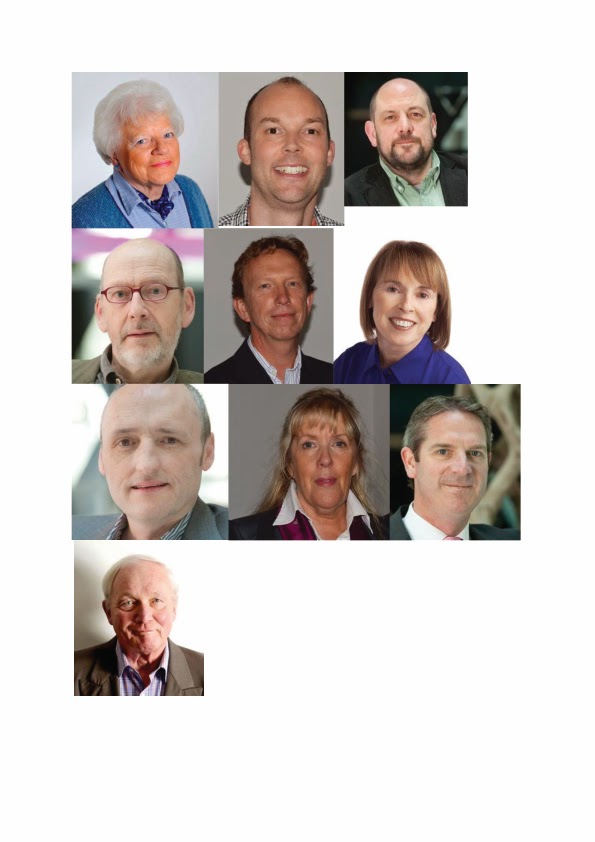
At that time, February, the Board looked like this [see montage on the right]:

Since then the Creative Scotland Board has been given another stir by Fiona Hyslop.  The corporate blurb on who is now who can be read - and seen - here.  While the gender balance may well have been fixed, it is obvious that the Board remains more than a little pale and not that interesting.

Early in August Hyslop and Creative Scotland oozed oleaginous self-congratulation on how the Board had reached the 50:50 gender target, and that it was the first body to do so since Nicola Sturgeon had launched the Partnership for Change on 25th June.  In all of the unctuous drooling over having achieved the First Minister's directive on gender balance in less than 2 months, careful study of the text reveals that government is quietly constructing a hierarchy of equality in Scotland.

While there can be no question but that the elimination of gender discrimination from the Board's of Scotland's public bodies is long overdue, this cannot and must not be achieved at the expense of creating a hierarchy in the work being done to eliminate discrimination across all groups of people who experience discrimination in their lives on a daily basis.

If the Board of Creative Scotland can be made to achieve a gender balance within 2 months of the directive issued by Nicola Sturgeon, it is fair to ask just where the directive is on bringing a racial balance to the Board of Creative Scotland, and just when will it be achieved?  If gender balance on public and third sector boards is to be achieved by 2020, why has Nicola Sturgeon not set a timetable for race equality to be achieved on those same boards ?  The absence of similar directives for balancing boards in relation to disabled and non-disabled people suggests that this community of people is also being pushed further back in the equality queue being created by Scottish government.


it is already obvious that the government's record on
equality lacks credibility and that if you are Black
Minority Ethnic or disabled, Ms Sturgeon will
 not always
do her best for you

The First Minister at the recent SNP 2015 conference invited people to judge her government on its record and to always do the best for you.  With the conference reports barely old enough to wrap this week's deep-fried Mars Bar suppers, it is already obvious that the government's record on equality lacks credibility and that if you are Black Minority Ethnic or disabled, Ms Sturgeon will not always do her best for you.

Wednesday, 7 October 2015

Scotland's Councils blame women for equal pay gaps

Recent research shows that the NHS in Scotland is failing to live up to a promise made by the current First Minister, Nicola Sturgeon, in 2009 that on equal pay Scotland's NHS would go beyond the letter of the law and be exemplary.  It may well be of course that Ms Sturgeon's abilities at arithmetic, and hence her capacity to keep her promise, are somewhat limited.

Given the glacial pace at which the NHS is closing the equal pay gap, it seemed worth checking what was happening in Scotland's other big public sector employers, the Councils.
There are 32 Councils in Scotland.  Recent research reveals that there appear to be at least 32 different ways to carry out equal pay audits and publish the findings.  The City of Edinburgh Council is way out there on its own in how it presents equal pay data.  It does look as if Edinburgh's equal pay gap table would be more at home in the Sudoku pages of newspapers and magazines rather than in a report to elected members on the Council's equal pay gap.  It does also beg the question what elected members thought the pay gap was/is when they nodded through the report earlier this year.


Councils have had over 40 years now to embrace the work required to deliver equal pay for women. The stark and obvious reality is that for Scotland's Councils, making equal pay happen for women remains something which they have reluctantly embraced and suspect most of them would rather they had to take turns dancing with the corpse of Margaret Thatcher than close the equal pay gap.

This lack of enthusiasm for eliminating gender discrimination is reflected in the emerging visibility of the substructure of organisational pay gaps, where the most common causes are identified in Council reports as the preponderance of women in low paid and/or part time work, with it being implied that women are choosing these jobs and so culpable in creating the organisational gender pay gaps. 

There is a complete absence in equal pay gap reports published by Councils of any recognition or understanding of the cultural, historical and political elements which created and sustains the institutional discrimination in relation to gender which permeates society and its structures, of which Councils themselves are a part.  It is no surprise that with the absence of that understanding, Councils have no real plans for eliminating the gender discrimination embedded in their workplaces in the form of occupational segregation.  As Argyll & Bute Council put it so eloquently:

“The persistence of the overall organisational pay gap is, like most local authorities, mainly caused by the relative numbers of lower paid female dominant roles.”


“The remaining organisational pay gap is mostly reflective of the relative large numbers of lower paid female employees in high number occupancy roles. This is not anomalous in a local authority context.”

Sometimes pictures do indeed speak louder than words, and the equal pay gap performance table below, based on what data Councils themselves have published, provides a lament for the continuing exploitation of women by the power systems and structures in Scotland where men still hold sway.